

UAT Is Broken. We Fixed It.
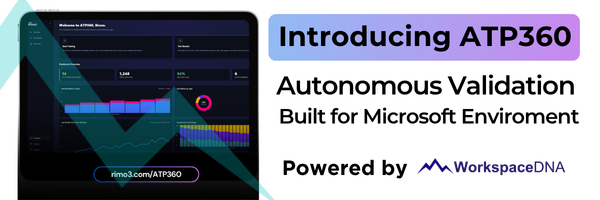
Introducing ATP360 | Autonomous Validation Built for Microsoft Enterprise Workspaces
Let's say the quiet part out loud.
You have thousands of applications. Your validation team has bandwidth for maybe 10–30% of high-risk paths per cycle. So every sprint, every patch cycle, every Windows update, someone makes a quiet little list: what we'll test, and what we'll hope for.
That's the part nobody talks about.
The rest? It ships. Not because nobody cares. Because the calendar doesn't slow down for validation capacity.
The hidden cost isn't what you test. It's what you can't.
Most enterprises have quietly made peace with this tradeoff. The cost is just… distributed. A deployment delayed because validation becomes the bottleneck. A patch deferred because nobody can prove it's safe. An audit finding where the evidence doesn't quite match what actually happened. A contractor brought in to paper over the gap. Manual testing that eats someone's week and then lives in a PowerPoint nobody opens again. Engineers burning cycles on repetition instead of innovation. Tribal knowledge that walks out the door every time somebody changes roles.
And then there's the one nobody wants to say out loud:
You're deploying change without knowing what's going to happen.
That's not a process gap. That's a tooling limitation. And the tooling has been wrong for a decade.
The solution you were handed doesn't fit the problem
UAT isn't broken because teams aren't trying hard enough. Modern workspaces outgrew it.
Every "solution" for this problem — every single one — rests on the same three-step fantasy:
- A human writes a script.
- A machine runs it.
- Someone reviews the result.
That model worked when change was slower, environments were simpler, and your application estate fit on a spreadsheet. None of those things are true anymore.
What you actually get:
- Scripts so brittle they snap when a button moves three pixels
- "Coverage" that never expands past the same critical sliver
- Validation cost that scales linearly with application count (i.e., badly)
- A system that demands more people every time Microsoft ships more change
That's not scaling. That's survival.
We didn't optimize that model. We replaced it.
.png?width=795&height=265&name=Email%20Banners%20(1).png)
ATP360 isn't a better testing tool. It's a different model.
Every change in your Microsoft environment carries risk. ATP360 validates it — applications, patching, configurations, infrastructure, workflows — before it reaches production. We call the category Autonomous Validation, and the outcome it produces is Agent-Verified Accuracy: evidence your changes will work, before users feel them.
Here's what that actually means:
No scripts. Nothing to write. Nothing to maintain. Nothing to break the next time Microsoft redesigns a dialog box at 2am. The system ingests your existing docs, videos, or notes and turns them into structured validation logic. That's it.
AI that reasons, not guesses. ATP360 doesn't just run steps. It observes the environment, interprets intent, adapts when something unexpected happens, and — when something fails — performs root-cause analysis. Out loud. In English. RPA is a workhorse. ATP360 makes judgments.
Humans in control. This is not an autonomous agent doing whatever it wants in your tenant. You set the hard thresholds — step caps, cost limits, retry maximums. Execution is scoped to pre-production. Every decision is inspectable and auditable. Governed AI, not unrestricted automation.
Tenant-contained by design. Everything runs inside your Azure environment. We support local LLM deployment so sensitive application data never leaves your perimeter. No exfiltration. No shared model getting smarter on your private apps. Your estate stays your estate.
Audit-ready evidence. Every run produces structured, explainable output — a screenshot at every step, full reasoning traces, JSON execution records. The kind of evidence that holds up when an auditor shows up in a bad mood. Forensic-ready, not a black box.
▶️Watch the UAT is Broken: Here's What We Did About It
.png?width=795&height=265&name=April%2016%20Webinar%20Email%20Banner%20(3).png)
What actually changes
You don't suddenly start manually testing everything. You stop being forced to choose between speed, coverage, and confidence.
The question shifts.
From: Did we test enough? To: Do we actually know what's going to work?
From deploy-and-hope, to validate-and-know.
Weeks collapse into minutes. Same coverage. No dedicated test engineers. Every change validated before users feel it. Every run leaves a regulator-ready trail.
Private Preview is now open!
ATP360 enters Private Preview. We're selecting a small group of enterprise Design Partners — the kind of teams who've felt every one of the tradeoffs above and are ready for something genuinely different.
What Design Partners get:
-
ATP360 running inside your own Microsoft tenant
-
Direct access to our product team — you shape the roadmap
-
Onboarding with your real applications and workflows
-
Exclusive Design Partner pricing
If you're running a large Microsoft estate, dealing with continuous change, and genuinely tired of choosing between speed and certainty:
→ Join the ATP360 Private Preview
The solution your Microsoft environment needed didn't exist.
Until now.
We didn't patch the old system.
We replaced it.
.webp?width=290&name=Samit%20Headshot%20(1).webp)